Kategorie: OpenWeb Notizen

  • Open .tel
    Telnic Limited, der Registrar der .tel Domains, kündigt hCard, OAuth and OpenID Support an.

    Two of the things we’re working on at present to enhance .tel services are integrating OAuth (Open Authentication) and OpenID into .tel. I’m personally excited about this as I think that this will bring huge benefits to many people and realize a vision for .tel that encourages people to see it, not as a traditional domain name, but as more of a communications solution.

    » Developments in OAuth and OpenID
    » Telnics Portability Policy

    Happy Birthday Microformats
    Die Microformats werden fünf Jahre alt und der geistige Vater, Tantek Çelik zieht Resumé.

    […] the number of pages published with one or more hCards recently crossed the 2 billion mark a few days ago according to Yahoo Search Monkey […] 94% of the time that data for rich snippets is marked up with microformats […]

    » microformats.org at 5: Two Billion Pages With hCards, 94% of Rich Snippets

    OpenID, Facebook oder Twitter?
    Die social optimization platform Gigya zeigt mit einer Infografik, welche Online Identities ihre User zum Anmelden nutzen. Im Gegensatz zu Echo (hauptsächlich Yahoo! Anmeldungen) und RPX (hauptsächlich Google Anmeldungen) hat bei Gigya erstmals Facebook die Nase vorne!

    » Which Identities Are We Using to Sign in Around the Web?
    » Identity Infographic
  • Trusted Identities in Cyberspace

    Die amerikanische Regierung veröffentlicht ein erstes Paper zur National Strategy for Trusted Identities in Cyberspace.

    Today, I am pleased to announce the latest step in moving our Nation forward in securing our cyberspace with the release of the draft National Strategy for Trusted Identities in Cyberspace (NSTIC). This first draft of NSTIC was developed in collaboration with key government agencies, business leaders and privacy advocates.

    In wie weit Organisationen wie die Open Identity Exchange-, OpenID– oder Information Card-Foundation involviert sind, geht aus dem Paper noch nicht ganz hervor.

    » National Strategy for Trusted Identities in Cyberspace
    » Open Identity Exchange

    Messenger Connect

    Microsoft will sich mit Messenger Connect einen Platz neben Facebook Connect, Google Friend Connect, Sign in with Twitter, MySpaceID und Yahoo! ID erkämpfen.

    Messenger Connect allows users to communicate, share, and connect with their Messenger friends on other websites. It is a flexible, yet prescriptive set of APIs to help create intuitive experiences that can be tightly integrated into a website or another app.

    Die Redmonder setzen dabei fast ausschließlich auf offene Standards: OAuth WRAP, Portable Contacts, ActivityStrea.ms, und OData. Außerdem folgen sie höchst ehrbaren Prinzipien:

    • Data portability (you own your data)
    • You have control over your data
    • Right data for the right scenario

    Beim lesen der Blogposts könnte man meinen man wäre versehentlich im DataPortability Wiki gelandet 🙂 …mal schau’n was Microsoft daraus macht!

    » Windows Live Messenger Connect is now available

    Plaudern über XMPP

    Die VZ-Gruppe testet das Extensible Messaging and Presence Protocol für ihren Plauderkasten. Großartig!

    » XMPP Chat Beta

  • Kolumne: Pfefferles OpenWeb
    Am Freitag (den 25.06.) ist die neue Ausgabe des Webstandards-Magazin im (Bahnhofs- und Flughafen-) Handel erhältlich. Auf Seite 88/89 gibt’s die Print-Version der OpenWeb-Notizen (naja fast) zu den Themen: NASCAR Problem, XAuth, OExchange, Mozillas Online Identity Concept Series und Facebooks OpenGraphProtocol.

    Kaufen!

    » Webstandards-Magazin: Ausgabe 06.2010

    Portability Policy
    Die DataPortability Group veröffentlicht jetzt offiziell die Portability Policy.

    In the same way that your Privacy Policy tells visitors what you can do with information they provide, your product’s Portability Policy tells visitors what they can do with it.

    » Announcing the Portability Policy
    » Policy Generator
    » Deleting Your Account: Data portability policy questions for a graceful exit

    OpenTransact
    Nicht mehr ganz neu, aber ich hab’s erst jetzt entdeckt: OpenTransact will eine Art Offener Standard für Payments sein.

    OpenTransact aims to create the equivalent of the HTTP standard for financial transactions. It is based on established well known HTTP, REST and OAUTH standards.

    » OpenTransact
    » Video: OpenTransact: rel-payment and OpenID

    OpenID Delegation
    Nat Sakimura erklärt wie man die eigene Domain mit relativ wenig Aufwand zu einer OpenID macht. Das Thema OpenID Delegation wurde bisher leider etwas stiefmütterlich behandelt, obwohl es wahrscheinlich die einfachste und sicherste OpenID Variante ist.

    » How to Set Up OpenID on Your Own Domain with fallback proivder

    Gravatar <3 hCard
    Automattic zeichnet die Gravatar-Profilseiten mit dem hCard Microformat aus… schön 🙂

    » Profile Pages <3 hCard
    » Microformat: hCard

  • OpenID-Plugin für Safari
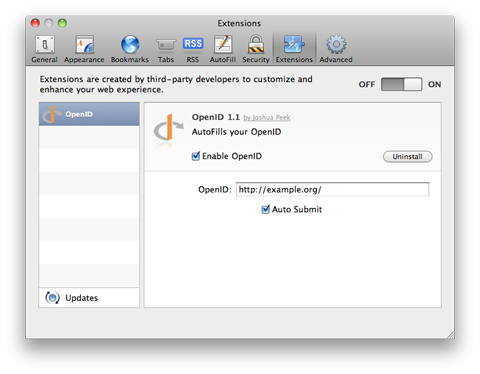
    Safari 5 (mit Addon-Support) ist gerade mal eine starken Woche alt und schon gibt es die erste OpenID-Erweiterung.

    OpenID-Plugin für Safari

    Das Plugin kann zwar nicht viel mehr als OpenID-Felder automatisch auszufüllen, aber wie heißt es so schön… immerhin mal ein Anfang.

    » openid.safariextension

    { „protocol“:“pubsubhubbub“, „format“:“json“ }
    Monica Keller (Facebook) und Martin Atkins (Six Apart) arbeiten an einer JSON-Variante von pubsubhubbub. Besonders Facebook, deren OpenGraph-API ausschließlich auf der JavaScript serialisierung basiert, scheint großes Interesse an dem offenen Push-Protokoll zu haben. Schön dass der Internet-Gigant sich die Mühe gibt, einen Standard voran zu treiben, anstatt ein eigenes Format zu entwickeln.

    » Spec: PubSubHubbub for JSON
    » Talk: PubSubHubbub for JSON

    HTML5 Microdata
    Ein weiterer ausführlicher Artikel über Microdata mit ein paar schönen Anwendungsfällen.

    » HTML5 Microdata: Welcome to the Machine

  • XAuth oder NixAuth?

    Das Thema XAuth wird gerade heftigst diskutiert. Ist XAuth ein Privacy Issue oder das Mittel gegen die NASCAR-Buttons?

    open != better

    Eran Hammer-Lahav über den Trugschluss: „open“ wäre das Mittel gegen Facebook.

    Well, the open community can’t beat Facebook.

    But companies using open technologies can – by building better products. Outside the echo chamber of web standards fanatics, the vast majority of web users don’t care about how the web works. They care about their user experience, where their friends are, and when something goes wrong, protecting their privacy.

    Activity Streams bei GNIP

    <entry>
      <title>GNIP unterstützt jetzt auch die ActivityStreams - Syntax.</title>
      <activity:verb>http://activitystrea.ms/schema/1.0/like</activity:verb>
    </entry>Code-Sprache: HTML, XML (xml)

    Mr. Topf für auf die Ohren

    Mein OpenWeb-Podcast Kollege Christian Scholz war die letzte Woche sehr audio-präsent! Er spricht mit dem Deutschlandfunk über „Facebook und die Alternativen“, mit mir über „OAuth 2“ und im Data Without Borders-Podcast unter Anderem über die „Portability Policy“.

  • Chris Messina erklärt XAuth
    XAuth ist eine Art Cross-Domain Cookie mit dem man Versucht die Flut an Share, Like und Login Icons auf ein Minimum zu reduzieren.

    Hier klicken, um den Inhalt von Vimeo anzuzeigen.
    Erfahre mehr in der Datenschutzerklärung von Vimeo (öffnet in neuem Tab).

    » XAuth – an introduction
    » Offizielle XAuth Seite

    OExchange einfach erklärt
    OExchange ist ein offenes Protokoll um eine beliebige URL mit einem beliebigen Service im Web zu teilen. Die Demo zeigt die Funktionsweise von OExchange und welche Vorteile sich in Kombination mit z.B. XAuth ergeben.

    Hier klicken, um den Inhalt von YouTube anzuzeigen.
    Erfahre mehr in der Datenschutzerklärung von YouTube (öffnet in neuem Tab).

    » OExchange in action
    » Offizielle OExchange Seite

    Firefox Sync
    Mozilla benennt das Labs-Projekt Weave Sync in Firefox Sync um und kündigt an, den Sync-Mechanismus in eine der nächsten Firefox Versionen fest zu integrieren. Im Zuge meiner Recherche bin ich außerdem noch auf einen Wiki-Artikel gestoßen, der erklärt wie man den Firefox Sync zukünftig auch mit OpenID oder OAuth koppeln könnte:

    The user must have a way of proving to a third-party service that they really are who they claim, and for the Mozilla service to provide information back to the third-party service that access has been granted. The OpenID and OAuth protocols provide what we need here, and the OpenID/OAuth hybrid flow has been described.

    Once this is done, the third party service will be able to establish a relationship with the Weave Sync service for a user, without the user disclosing his or her password.

    » Stay in Sync With Your Firefox
    » Firefox Sync Graduates from Mozilla Labs
    » Secure Data Sharing

    RDFa 1.1 – Alles neu, alles anders
    Dank HTML5 (ohne X) wurde RDFa noch einmal grundlegend überdacht. In der Version 1.1 werden die RDF-Vocabularies beispielsweise nicht mehr über Namespaces definiert. Früher:

    <a xmlns:cc="http://creativecommons.org/ns#"
       rel="cc:license"
       href="http://creativecommons.org/licenses/by-nc-nd/3.0/">
    </a>.Code-Sprache: HTML, XML (xml)

    Jetzt:

    <a prefix="cc: http://creativecommons.org/ns#"
       rel="cc:license"
       href="http://creativecommons.org/licenses/by-nc-nd/3.0/">
    </a>.Code-Sprache: HTML, XML (xml)

    Grund der Änderung: HTML kennt im Gegensatz zu XHTML keine Namespaces und RDFa soll sowohl in HTML5 als auch in XHTML5 integriert werden.

    » RDFa Core 1.1

    RDFa checker
    Toby Inkster hat einen sehr umfangreichen RDFa checker veröffentlicht:

    It checks your web page for RDFa and displays any data found there. It also compares your data against the published recommendations from major consumers/users of RDFa data, to see how well your data matches their requirements.

    » check rdfa

  • Da ich in den letzten Monaten nicht wirklich viel Zeit zum bloggen hatte, im (Open)Web aber trotzdem viel zu viel interessantes passiert und ich hackrs kurzen und prägnanten Schreibstil sehr schätze, versuche ich mich jetzt mal an einer OpenWeb-Version von Linkwertig und nenne es „OpenWeb-Notizen„… Das versuche ich jetzt mal jeden Mittwoch zu machen… eine Art OpenWeb-Wednesday so zu sagen…

    DiSO 2
    Steve Ivy (Mitbegründer des DiSo-Projekts) interviewt Tantek Çelik (geistiger Vater der Microformats) zu Distributed Social Networks. Im aktuellen Interview spricht Tantek über URL-Shortener: warum sie das Internet „verletzen“, warum man sie dennoch braucht, warum jeder seinen eigen Shortening-Service betreiben sollte und wie er das Problem für sich gelöst hat.

    » Interview: Tantek Celik, Conceptualizing DiSo 2.0
    » Tantek Celik on DiSo 2.0: Down to Brass Tacks

    Tantek Çelik unterstützt Mozilla
    …und nochmal etwas vom Mr. Microformat. Tantek soll dem Firefox-Team während der nächsten Monate mit seiner Open-/Web-Standards Erfahrung zur Seite stehen:

    My belief is that by basing our work on simple, open, accessible Web standards, that we can help usher in a whole new era of distributed social Web sites.

    » Mozilla hires open-standards guru Celik

    Umfassende Microdata-Einführung
    Mark Pilgrim befasst sich in seinem frei erhältlichen Online-Buch „Dive Into HTML5“ auch sehr detailliert mit dem Thema Microdata. Sehr empfehlenswert für Einsteiger und Fortgeschrittene!

    » „Distributed“, „Extensibility“, & Other Fancy Words

    Portability Policy
    Die DataPortability Organisation veröffentlicht die Portability Policy. Die Policy soll eine Art standardisierte Zusammenfassung der Privacy Policy und der Terms of Services sein, mit der Plattformbetreiber auf die Portabilität ihrer Daten hinweisen können.

    » Portability Policy

    (Video) Podcasts
    Es gibt wieder neue Folgen von „The SocialWeb TV“ und dem „OpenWebPodcast“:

    » SocialWeb TV: Making Sense of Recent News
    » OpenWebPodcast: Episode 29 – OpenWebNews