Email to ID hat seine Spezifikation. Email Address to URL Translation (kurz EAUT) ist ein offenes Protokoll um E-Mail – Adressen zu URLs zu transformieren um sie für Services wie z.B. OpenID verwenden zu können.
Email Address to URL Transformation (EAUT) defines a mechanism for transforming the „addr-spec“ portion of an RFC2822 email address into an associated URL. The transform options outlined in this document are designed to be flexible enough such that every DNS domain-owner can specify unlimited email address to URL transformations that services can easily discover and utilize in their URL-based transactions.
Das Prinzip ist einfach:
- Zuerst wird die EAUT Discovery Endpoint URL ermittelt. Bei der E-Mail – Adresse
matthias@pfefferle.orgwäre die URLpfefferle.org. - Als nächstes wird unter der URL nach Discovered Information (XRDS-Simple) gesucht.
- Sind Informationen verfügbar, wird die E-Mail – Adresse entsprechend der Vorgaben gemappt.
- Gibt es keine passenden XRDS-Simple Daten, werden Mapper wie z.B. Email to ID empfohlen.
Wen interessiert welche Schritte genau durchgeführt werden oder ob der eigene E-Mail – Provider ein entsprechendes Mapping unterstützt, kann seine E-Mail – Adresse hier testen (Beispiel: matthias@pfefferle.org).
Examples in the wild
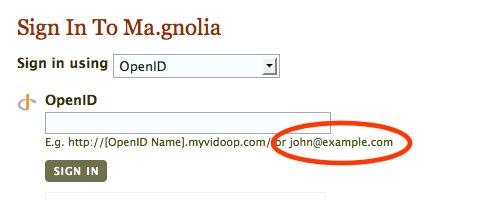
Der erste Service, der die Email Address to URL Translation Spezifikation umgesetzt hat ist Ma.gnolia.com:
Just wanted to let everyone know that we just deployed EAUT support over at Ma.gnolia (http://ma.gnolia.com). You can now type in your email address in the OpenID field and we’ll resolve using EAUT with https://web.archive.org/web/20080929085748/http://emailtoid.net/ as the default.
Will Norris hat EAUT außerdem in sein OpenID WordPress Plugin (Version 2.2.0) implementiert.