Zum Inhalt springen

notizBlog

  • About
  • Follow me
  • Kontakt
  • Appearances
  • /now
  • /slashes
  • About (me)
  • Appearances
  • Artikel
  • Podcasts
  • Archiv
  • Blank
  • Blogrolle
  • Changelog
  • Donate
  • Follow me
  • Followers
  • Kontakt
  • Thanks! ❤️🙌
  • Datenschutzerklärung
  • Impressum
  • Link

    OpenWeb-Notizen: W3C, UfXtract, WebID, OExchange

    Benutzerbild von Matthias Pfefferle

    by

    Matthias Pfefferle

    28. Juli 2010
    Open Web, OpenWeb Notizen

    Das W3C und das Open Web
    Das World Wide Web Consortium will sich in Zukunft nicht mehr ausschließlich auf Webstandards konzentrieren, sondern einen „attraktiven Platz“ für offene Standards aller Art schaffen. Beispielhaft erwähnte Formate sind z.B. OStatus (Salmon Protocol, ActivityStreams, Pubsubhubub, …), OneSocialWeb, OExchange, WebFinger uvm.

    » Making W3C the Place for New Web Standards
    » Wiki-Seite

    UfXtract jetzt Open Source
    Glenn Jones hat den Quellcode seines Microformats-Parsers UfXtract veröffentlicht.

    UfXtract is a fast and easy to use .Net microformats parser. With a few lines of code you can load and parse microformats from Urls or HTML strings. You can then extract the data directly in .Net or convert it into JSON, JSON-P or XML.

    » GitHub Repository
    » ufXtract Webservice

    Aus foaf+ssl wird WebID
    Die OpenID Community hat ja bereits erkannt dass der Otto-Normal-User einige Probleme mit URLs als Identifier hat. Das scheint das W3C aber nicht weiter zu stören.

    A Web ID is an „Identifier“ (an „HTTP URI“ in fact), for Entity „You“ […] It looks like a URL and feels like a URL, but isn’t solely a URL, due to the inherent Identity/Access duality of HTTP scheme URIs.

    Hört sich simpel an 😉

    » A Web ID
    » OpenWeb-Podcast: Episode 25 – FoaF+SSL

    AddThis baut ausschließlich auf OExchange
    AddThis integriert in Zukunft nur noch Dienste die das OExchange-Protokoll unterstützen. Mal schau’n wie konsequent sie sind 😉

    Today, we’ve released a new workflow for submitting new services (i.e. social networks, online communities, etc) to the AddThis Service Directory that requires all new services support the sharing protocol OExchange.

    » OExchange Support Now Required for New Service Submission
    » OExchange Submission Flow
    Keine Kommentare
  • Link

    OpenWeb-Notizen: Salmon und der OpenStack

    Benutzerbild von Matthias Pfefferle

    by

    Matthias Pfefferle

    21. Juli 2010
    Open Web, OpenWeb Notizen

    Cliqset Salmon demonstration
    Blogposts werden bei Twitter kommentiert oder bei Facebook ge-„liked“, nur das Blog bekommt relativ wenig davon mit und sein Autor darf deshalb auf die Suche nach den diversen Reaktionen gehen. Mit dem Salmon-Protocol soll damit Schluss sein. Kommentare auf Facebook könnten dank Salmon zusätzlich an den Ursprungs-Artikel zurück „geführt“ werden und somit die Kommunikation von den verteilten Netzen wieder an einer Stelle vereinen. Cliqset zeigt in einem Screencast, wie Salmon in Kombination mir Webfinger und Pubsubhubbub sogar dezentrales microbloggen zulassen.

    Hier klicken, um den Inhalt von YouTube anzuzeigen.
    Erfahre mehr in der Datenschutzerklärung von YouTube (öffnet in neuem Tab).

    „Cliqset – Salmon demonstration“ direkt öffnen

    » Cliqset Salmon demonstration
    » Salmon-Protocol

    OpenStack oder OpenStack?
    Der OpenStack hat sich als Begriff für die offene Alternative zu Facebook-Connect durchgesetzt: OpenID + OAuth + Portable Contacts + Open Social + XRDS/XRDS-Simple/XRD/Webfinger. Bisher! Leider entfremdet Rackspace OpenStack jetzt für das eigene Open Source Server-Cloud-System.

    Innovative, open source cloud computing software for building reliable cloud infrastructure.

    …es wäre schade wenn man in Zukunft aus jedem Buzzword gleich ein Trademark machen müsste um seine Bedeutung längerfristig zu sichern.

    » OpenStack Open Source Cloud Computing Software

    1 Kommentar
  • Link

    OpenWeb-Notizen: federated social web, Facebook, Microsoft

    Benutzerbild von Matthias Pfefferle

    by

    Matthias Pfefferle

    14. Juli 2010
    Open Web, OpenWeb Notizen

    The federated social web
    Chris Messina nennt es Distributed Social Network (kurz DiSo), Khris Loux nennt es SynapticWeb, Chris Saad nennt es Interoperable Web und Evan Prodromou führt einen weiteren Begriff ein: „federated social web„. Der Status.Net (vorher identi.ca/laconi.ca) Gründer erklärt in zwei Blogposts sehr ausführlich und anschaulich was das „federated social web“ ist und wie es funktionieren könnte.

    “Open” can mean a lot of different things. A federated social web is specific: it means that there are distinct entities that control parts of the system, but those parts are connected with agreed-upon rules to make a pleasing and usable whole.

    Oder wie Chris Saad es ausdrückt Open is not enough. Time to raise the bar: Interoperable

    » What is the federated social web?
    » Features of a federated social web

    Facebook und der Social Graph
    Facebook packt neben hCards und XFN jetzt auch rel-me links auf die Profilseiten.

    Facebook joins the distributed social web #DiSo by supporting rel-me + representative hCard microformats!

    …das gibt ’nen schönen Backlink 😉

    » Facebook joins the distributed social

    Microsofts Identity “Mash-up”
    Microsoft bastelt an einem Identity “Mash-up” und kombiniert die unterschiedlichsten Systeme miteinander.

    […] we chose to create an intermediary Security Token Service that understands the OpenID protocol (used by PayPal), WS-Federation protocol and SAML 1.1 tokens (used by Medtronic apps). This intermediary STS enables SSO between the web applications, avoiding re-authentication with the original identity provider (PayPal).

    Und warum das ganze? Weil ’s geht 🙂

    » Consumer Identities for Business transactions
    » Identity “Mash-up” Federation Demo using Multiple Protocols (OpenID and WS-Federation)

    Keine Kommentare
  • Link

    OpenWeb-Notizen: .tel Portability, 5 Jahre Microformats, Identity Infographic

    Benutzerbild von Matthias Pfefferle

    by

    Matthias Pfefferle

    8. Juli 2010
    Open Web, OpenWeb Notizen

    Open .tel
    Telnic Limited, der Registrar der .tel Domains, kündigt hCard, OAuth and OpenID Support an.

    Two of the things we’re working on at present to enhance .tel services are integrating OAuth (Open Authentication) and OpenID into .tel. I’m personally excited about this as I think that this will bring huge benefits to many people and realize a vision for .tel that encourages people to see it, not as a traditional domain name, but as more of a communications solution.

    » Developments in OAuth and OpenID
    » Telnics Portability Policy

    Happy Birthday Microformats
    Die Microformats werden fünf Jahre alt und der geistige Vater, Tantek Çelik zieht Resumé.

    […] the number of pages published with one or more hCards recently crossed the 2 billion mark a few days ago according to Yahoo Search Monkey […] 94% of the time that data for rich snippets is marked up with microformats […]

    » microformats.org at 5: Two Billion Pages With hCards, 94% of Rich Snippets

    OpenID, Facebook oder Twitter?
    Die social optimization platform Gigya zeigt mit einer Infografik, welche Online Identities ihre User zum Anmelden nutzen. Im Gegensatz zu Echo (hauptsächlich Yahoo! Anmeldungen) und RPX (hauptsächlich Google Anmeldungen) hat bei Gigya erstmals Facebook die Nase vorne!

    » Which Identities Are We Using to Sign in Around the Web?
    » Identity Infographic

    Keine Kommentare
  • Link

    OpenWeb-Notizen: Trusted Identities, Messenger Connect, VZ, XMPP

    Benutzerbild von Matthias Pfefferle

    by

    Matthias Pfefferle

    30. Juni 2010
    Open Web, OpenWeb Notizen

    Trusted Identities in Cyberspace

    Die amerikanische Regierung veröffentlicht ein erstes Paper zur National Strategy for Trusted Identities in Cyberspace.

    Today, I am pleased to announce the latest step in moving our Nation forward in securing our cyberspace with the release of the draft National Strategy for Trusted Identities in Cyberspace (NSTIC). This first draft of NSTIC was developed in collaboration with key government agencies, business leaders and privacy advocates.

    In wie weit Organisationen wie die Open Identity Exchange-, OpenID– oder Information Card-Foundation involviert sind, geht aus dem Paper noch nicht ganz hervor.

    » National Strategy for Trusted Identities in Cyberspace
    » Open Identity Exchange

    Messenger Connect

    Microsoft will sich mit Messenger Connect einen Platz neben Facebook Connect, Google Friend Connect, Sign in with Twitter, MySpaceID und Yahoo! ID erkämpfen.

    Messenger Connect allows users to communicate, share, and connect with their Messenger friends on other websites. It is a flexible, yet prescriptive set of APIs to help create intuitive experiences that can be tightly integrated into a website or another app.

    Die Redmonder setzen dabei fast ausschließlich auf offene Standards: OAuth WRAP, Portable Contacts, ActivityStrea.ms, und OData. Außerdem folgen sie höchst ehrbaren Prinzipien:

    • Data portability (you own your data)
    • You have control over your data
    • Right data for the right scenario

    Beim lesen der Blogposts könnte man meinen man wäre versehentlich im DataPortability Wiki gelandet 🙂 …mal schau’n was Microsoft daraus macht!

    » Windows Live Messenger Connect is now available

    Plaudern über XMPP

    Die VZ-Gruppe testet das Extensible Messaging and Presence Protocol für ihren Plauderkasten. Großartig!

    » XMPP Chat Beta

    Keine Kommentare
  • Standard

    t3n: Login leicht gemacht

    Benutzerbild von Matthias Pfefferle

    by

    Matthias Pfefferle

    29. Juni 2010
    Open Web

    Der Artikel "Single-Sign-On mit Facebook, Twitter und dem Open Stack", den ich für Ausgabe 19 des t3n Magazins geschrieben habe, ist jetzt kostenlos im Heftarchiv verfügbar.

    Immer mehr Webdienste erleichtern ihren Nutzern die Anmeldung, indem Sie statt einer langwierigen Registrierung auf den einfachen Login mit „Facebook Connect“ oder „Sign in with Twitter“ setzen. Wir zeigen, wie das funktioniert, welche Vorteile und Risiken sich daraus ergeben und warum es am Ende auf einen „Universal Login“ mit offenen Standards wie OpenID hinauslaufen könnte.

    Link: Single-Sign-On mit Facebook, Twitter und dem Open Stack

    Viel Spaß beim lesen…

    Keine Kommentare
  • Link

    OpenWeb-Notizen: Webstandards-Magazin, Portability Policy, OpenTransact, Gravatar

    Benutzerbild von Matthias Pfefferle

    by

    Matthias Pfefferle

    23. Juni 2010
    Open Web, OpenWeb Notizen

    Kolumne: Pfefferles OpenWeb
    Am Freitag (den 25.06.) ist die neue Ausgabe des Webstandards-Magazin im (Bahnhofs- und Flughafen-) Handel erhältlich. Auf Seite 88/89 gibt’s die Print-Version der OpenWeb-Notizen (naja fast) zu den Themen: NASCAR Problem, XAuth, OExchange, Mozillas Online Identity Concept Series und Facebooks OpenGraphProtocol.

    Kaufen!

    » Webstandards-Magazin: Ausgabe 06.2010

    Portability Policy
    Die DataPortability Group veröffentlicht jetzt offiziell die Portability Policy.

    In the same way that your Privacy Policy tells visitors what you can do with information they provide, your product’s Portability Policy tells visitors what they can do with it.

    » Announcing the Portability Policy
    » Policy Generator
    » Deleting Your Account: Data portability policy questions for a graceful exit

    OpenTransact
    Nicht mehr ganz neu, aber ich hab’s erst jetzt entdeckt: OpenTransact will eine Art Offener Standard für Payments sein.

    OpenTransact aims to create the equivalent of the HTTP standard for financial transactions. It is based on established well known HTTP, REST and OAUTH standards.

    » OpenTransact
    » Video: OpenTransact: rel-payment and OpenID

    OpenID Delegation
    Nat Sakimura erklärt wie man die eigene Domain mit relativ wenig Aufwand zu einer OpenID macht. Das Thema OpenID Delegation wurde bisher leider etwas stiefmütterlich behandelt, obwohl es wahrscheinlich die einfachste und sicherste OpenID Variante ist.

    » How to Set Up OpenID on Your Own Domain with fallback proivder

    Gravatar <3 hCard
    Automattic zeichnet die Gravatar-Profilseiten mit dem hCard Microformat aus… schön 🙂

    » Profile Pages <3 hCard
    » Microformat: hCard

    Keine Kommentare
  • Standard

    So viel zur Relevanz von OpenID…

    Benutzerbild von Matthias Pfefferle

    by

    Matthias Pfefferle

    18. Juni 2010
    Open Web

    Gerade kam eine E-Mail von Amazon:

    Nach Auskunft des Verlags bzw. Herstellers
    wird der folgende Titel leider nicht mehr aufgelegt:

    David Recordon, et al „Openid: The Definitive Guide“

    Dieser Artikel musste aus Ihrer Bestellung gestrichen werden.

    Vielleicht fehlt es Chris Messina und David Recordon aber auch einfach nur an Zeit… Keine Ahnung wie lange man an so ’nem Schmöker sitzt…

    Schade! Wäre sicherlich ein interessantes Buch geworden.

    3 Kommentare
  • Link

    OpenWeb-Notizen: OpenID, Safari, pubsubhubbub, microdata

    Benutzerbild von Matthias Pfefferle

    by

    Matthias Pfefferle

    16. Juni 2010
    Open Web, OpenWeb Notizen

    OpenID-Plugin für Safari
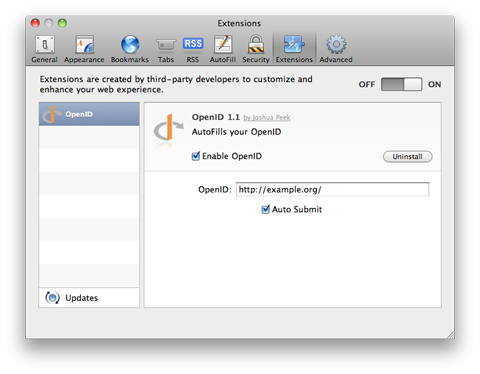
    Safari 5 (mit Addon-Support) ist gerade mal eine starken Woche alt und schon gibt es die erste OpenID-Erweiterung.

    OpenID-Plugin für Safari

    Das Plugin kann zwar nicht viel mehr als OpenID-Felder automatisch auszufüllen, aber wie heißt es so schön… immerhin mal ein Anfang.

    » openid.safariextension

    { „protocol“:“pubsubhubbub“, „format“:“json“ }
    Monica Keller (Facebook) und Martin Atkins (Six Apart) arbeiten an einer JSON-Variante von pubsubhubbub. Besonders Facebook, deren OpenGraph-API ausschließlich auf der JavaScript serialisierung basiert, scheint großes Interesse an dem offenen Push-Protokoll zu haben. Schön dass der Internet-Gigant sich die Mühe gibt, einen Standard voran zu treiben, anstatt ein eigenes Format zu entwickeln.

    » Spec: PubSubHubbub for JSON
    » Talk: PubSubHubbub for JSON

    HTML5 Microdata
    Ein weiterer ausführlicher Artikel über Microdata mit ein paar schönen Anwendungsfällen.

    » HTML5 Microdata: Welcome to the Machine

    Keine Kommentare
  • Standard

    DER microformats transformr

    Benutzerbild von Matthias Pfefferle

    by

    Matthias Pfefferle

    15. Juni 2010
    Open Web

    Nach etwas mehr als zwei Jahren und diversen Hosting-Problemen ist Martin McEvoys microformats transformr jetzt unter microform.at erreichbar.

    Martin McEvoys tweet

    Aber nicht nur die Domain hat sich geändert. Martin (aka Weborganics) hat noch einmal extrem viel Arbeit in den transformr gesteckt, so dass er mittlerweile nahezu alles transformiert was sich so im HTML-Quellcode versteckt:

    • Microformats: hCard, hCalendar, hReview, hAtom, geo, hAudio, XOXO, hMedia, XFN, rel-enclosure
    • Andere Formate: RDFa 1.0 + 1.1 @vocab @prefix, eRDF, OGP.

    …und die Liste der Ausgabe-Formate ist mindestens ebenso eindrucksvoll.

    Meine Favoriten sind der (von Martin überarbeitete) hCard2QRCode-transformr und der SPARQL Endpoint über den man vollen Zugriff auf alle zuvor transformierten Seiten hat.

    Vergesst Optimus, H2VX, microformatic und ufXtract!

    2 Kommentare
←Vorherige Seite
1 … 21 22 23 24 25 … 77
Nächste Seite→

notizBlog

  • /now
  • /slashes
  • Appearances
  • Blogroll
  • Changelog
  • Datenschutzerklärung
  • Donate
  • Follow me
  • Followers
  • Impressum
  • notiz.Blog
  • Thanks! ❤️🙌
  • About
  • Projekte
  • Artikel
  • Kontakt
  • I ❤️ RSS

← IndieWebring →

← Fediring →

← UberBlogr →

This site is powered by WordPress and styled with the Autonomie theme