Toby Inkster beschreibt auf seinem Blog sehr anschaulich, wie man eine hCard mit RDFa-Informationen erweitern kann.
While hCard offers many useful properties that can be used to describe contacts, some are considered beyond the scope of the hCard specification. For example, there is no hCard property to mark up somebody’s height, or shoe size.
This is where RDFa comes in. RDFa is not a specialist format for describing people or organisations, but a more general format for describing anything. We can use RDFa to add in the extra information we want.
Um einen guten sozialen Graphen abbilden zu können ist es wichtig, dass die Verlinkung über z.B. rel-me (oder FoaF oder OpenID-Delegation) bidirektional statt findet.
Um auch Community-Profile ohne Backlink-Möglichkeiten (z.B. facebook) verifizieren zu können, kam Brad Fitzpatrick (der Mann hinter Googles Social Graph API) auf die geniale Idee, den fehlenden Link mit einer qr-codierten URL in seinem Profilbild zu ersetzen.
…jetzt müssen die QR-Codes nur noch in die SG–API aufgenommen werden.
Personally, as I’ve fired up an increasing number of native apps on the iPhone 2.0 software, I’ve been increasingly frustrated and annoyed at how many of them want my username and password, and how few of them support this kind of delegated authorization flow. (Chris Messina)
…wird Zeit dass ich mir doch mal ein iPhone zulege.
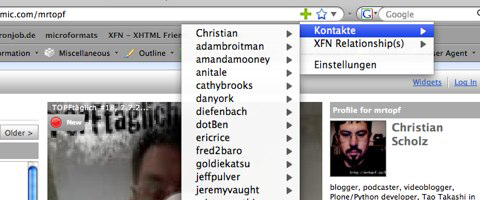
Seesmic scheint in nächster Zeit ne ganze Menge vor zu haben.
Auf dem Screenshot ist übrigens Mr. Topf zu sehen…
Der erste Schritt war wohl die Umstellung von reinem Flash zu mehr HTML, wahrscheinlich um Seesmic semantischer gestalten zu können (die ersten implementierten Formate sind XFN und hCards).
Aber das ist noch lange nicht alles, geplante sind unter anderem folgende Formate und offene Standards:
Open data formats: – RDF as the foundation, and exporters to microformats, HTML, RDFa… – We already use existing open metadata vocabularies – FOAF (for friend management) – SIOC (for community description) – Dublin Core for description of resources – In the process of using a subset of MPEG-7 ontology for video metadata.
Open identifiers: – Public URL scheme, and standardized authentication system. Considering the use of OpenID
Open source technologies: – Use Open Source projects wherever it’s possible. – Open Source critical pieces of the architecture, to allow for greater long term maintainability of complex pieces of software that are not core to the business and can benefit from the community.
Einfach dem dopplr-Vogel eine Freundschaftsanfrage schicken, dann eine Authentifizierungsnummer (bekommt man hier) schicken und warten bis dopplr bescheid gibt.
Danach kann man seinen neuen Standort bequem per d dopplr <Standort> oder @doppler <Standort> aktualisieren.
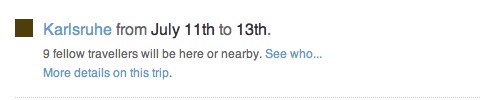
Das wäre ja schon schick genug, aber dopplr zeigt liebe zum Detail… Wird eine Location nicht gleich erkannt, wird sie archiviert, man bekommt per E-Mail bescheid:
Thanks for sending us a message by twitter.
Sorry, we weren’t able to extract enough information from your twitter to make a trip. We’ve archived it at http://www.dopplr.com/traveller/pfefferle/message/ne_lange_nummer
where you can create a trip by hand if you like.
Yours sincerely, The Dopplr Team.
…und man kann sie jederzeit (über dopplr) verbessern:
Wie schon im Lifestreamerwähnt, habe ich mir (um das Template nicht ändern zu müssen) ein simples six groups – Livecommunity WordPress-Plugin gebaut und vielleicht findet ja auch noch jemand anders Verwendung dafür… 🙂