Schlagwort: Microformats

Mikroformate sind ein Markup-Format zur semantischen Annotation von HTML oder XHTML. Mikroformat-Annotationen können leicht aus Webseiten extrahiert werden und machen weiteren Programmen (etwa Suchmaschinen) die Bedeutung des Seiteninhalts verständlich.

  • Cognition ist ein Parser (Perl 5) für alle möglichen Semantic-Web – und „lowercase semantic web“ – Standards:

    Cognition is a parser for both “upper case Semantic Web” (RDF, RDFa) and “lower case semantic web” (microformats) technologies. It includes modules for exporting parsed data in a variety of formats, including RDF, vCard, iCalendar, Atom and KML.

    Die Liste der unterstützten Metadaten und Semantiken ist definitiv zu lang um sie hier zu posten 🙂

    Keine Kommentare zu Cognition 0.1-alpha7
  • Vor ein paar Wochen wurde XRDS-Simple 1.0 (Draft 1) veröffentlicht. XRDS-Simple ist ein Standard, der auf bestehenden Standards der XRI Community aufbaut, auf den z.B. auch das von OpenID bekannte Yadis-Format basiert.

    XRDS-Simple provides a format and workflow for the discovery of resources metadata, and other linked resources. As web services continue to grow, applications utilize a wider range of web services and resources across multiple providers. XRDS-Simple allows providers to document their resources in a machine-readable way, which can be automatically discovered by consumer applications.

    XRDS-Simple bietet also ein recht simples Format um auf Services und andere „linked recources“ zu verweisen.

    XRDS-Simple als zentraler ServiceCatalogue

    Wie man dieses Format für das DataPortability Projekt nutzen kann hat Christian Scholz in seinem Post „The first Data Portability Use Case (somewhat technical)“ schön zusammengefasst.

    Nehmen wir an, ich melde mich bei einem neuen Dienst an und möchte meine Daten, die ich an anderen Stellen im Internet angegeben habe, wiederverwenden. Um nicht alle meine Profil-URLs immer wieder per Hand angeben zu müssen, kam die Idee eines ServiceCatalogues auf.

    Der ServiceCatalogue soll an zentraler Stelle alle Informationen die über mich im Web verfügbar sind (z.B. als hCard, XFN, FoaF, usw. formatiert) bereitstellen.

    <XRDS xmlns="xri://$xrds">
      <XRD xmlns:simple="http://xrds-simple.net/core/1.0" xmlns="xri://$XRD*($v*2.0)" version="2.0">
        <Type>xri://$xrds*simple</Type>
        <Service priority="10">
          <Type>http://www.w3.org/2006/03/hcard</Type>
          <URI simple:httpMethod="GET">http://pownce.com/pfefferle</URI>
        </Service>
        <Service priority="20">
          <Type>http://gmpg.org/xfn/11</Type>
          <URI simple:httpMethod="GET" priority="10">http://twitter.com/pfefferle</URI>
          <URI simple:httpMethod="GET" priority="20">http://pownce.com/pfefferle</URI>
        </Service>
      </XRD>
    </XRDS>Code-Sprache: HTML, XML (xml)

    Das Beispiel zeigt z.B. die URL zu meiner hCard bei Pownce und meinen Freundesnetzen bei Pownce und Twitter. Um diese Information vor unerlaubten Zugriffen zu schützen, könnte die XRDS-Simple URL mit OAuth geschützt oder per OpenID AX angefragt werden.

    XRDS-Simple mit AX abfragen

    Um XRDS-Simple via AX anzufragen, müsste man zuerst ein AX-Schema definieren:http://dataportability.org/schema/serviceCatalogue Label service catalogue Description The url to a XRDS-Simple formatted service catalogue Example http://example.org/sc.xrds Formatting http://www.w3.org/2001/XMLSchema#anyURI

    und unter http://dataportability.org/schema/serviceCatalogue bereitstellen. Leider funktioniert diese Art der Bereitstellung nur wenn einige OpenID-Provider diese AX-ServiceCatalogue-URL auch implementieren.

    2 Kommentare zu XRDS-Simple und DataPortability
  • Habt ihr nicht auch das Gefühl dass meine Überschriften immer kreativer werden?

    monkeyformats-header

    Albert de Klein, der Autor des zuvor erwähnten Monkeyformats-Artikel, hat seiner Idee jetzt eine Webseite spendiert.

    Warum Monkeyformats:

    Microformat adoptation can use a boost worldwide because it makes the web a better place. Monkeyformats allow users to experience the advantages of microformats on sites they use everyday but that have been lacking semantic markup so far without having to wait for those sites to add them eventually. Although still in its infancy there are already several monkeyformats available that add microformats to some national phone directories in Europe, ticket services, etc.

    Auf monkeyformats.org gibts noch ne Reihe weiterer Informationen unter anderem auch eine Anleitung wie man selbst neue Formate erstellt.

    Großartige Idee, großartiges Logo und noch großartigerer Name! 🙂

    3 Kommentare zu Die Affen bekommen einen eigenen Käfig
  • So, nachdem sich doch einiges bei Optimus[1] und Operator[2] geändert hat, hab ich auch mal mein Optimus User Script auf den neusten Stand gebracht.

    Änderungen seit der letzten Version:

    • URL von document.commandDispatcher.focusedWindow.document.URL auf semanticObject.node.ownerDocument.URL umgestellt.
    • Support für hAudio und hListing hinzugefügt

    Den Download findet ihr hier: Optimus User Script

    [1] Optimus ist ein Microformats-Parser auf Basis von XSLT.
    [2] Operator ist ein Firefox-Addon zum visualisieren und verarbeiten von Microformats.

    Keine Kommentare zu Optimus für Operator update
  • Optimus Transformer hat ne ganze Menge neuer Features spendiert bekommen, unter anderem auch Support für zwei der neueren Microformats hListing und hAudio.

    Alle neuen Features:

    • support of nested microformats
    • support of multiple includes
    • support of nested includes
    • support of anchor (you can use URL like http://example.com#my-vcard to narrow the target)
    • support of @couldbe attribute (internal feature, now item in hreview, for example, could be vcard or vevent)
    • hfeed now is optional
    • support for vcalendar
    • fix for text spacing
    • fix for empty tags in output
    • hListing support
    • hAudio support
    • general performance improvement
    • add RSS as an output format
    • rewrite validator from scratch
    • better UTF-8 support

    Das ist mittlerweile ne ganz stattliche Liste an unterstützten Mikroformaten, wenn jetzt nur noch alle Optimus-Ähnlichen-Services ein einheitliches JSON-Format zurückgeben würden…

    …und ich sollte mich definitiv mal etwas mehr mit XSLT beschäftigen!

    Keine Kommentare zu Neue Features bei Optimus Transformer
  • Albert de Klein beschreibt in seinem Artikel „Monkeyformats“ (und einigen Anwendungsbeispielen), dass man mit Hilfe von Greasemonkey, Webseiten nachträglich und relativ einfach mit Microformats auszeichnen kann.

    […] These client-side microformats work well with the Operator add-on and let you do microformatish things with websites that do not yet support microformats but might prove very useful as microformat examples. […] (via)

    Das Prinzip wirkt zwar auf den ersten Blick etwas umständlich, erspart einem aber letztendlich eine ganze Reihe an Arbeit. Microformats sind wohldefinierte Formate für die es schon eine ganzen Reihe an Programme und Services (z.B. Operator) gibt, die man mit Hilfe der Monkeyformats-Idee auch relativ einfach auf eigentlich „unsemantische“ Seiten anwenden kann.

    Funktionsweise

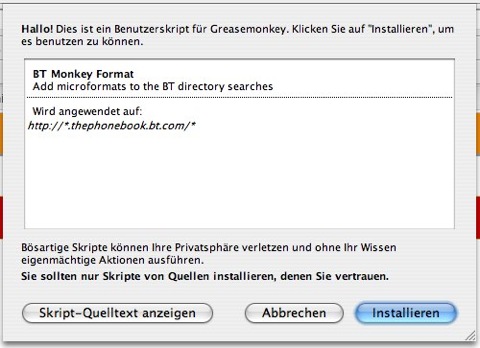
    greasemonkey-installation.jpg

    Nach der Installation einfach auf die entsprechende URL aufrufen (hier im Beispiel: www.thephonebook.bt.com) und schon wird aus einer normalen Webseite:

    without-greasemonkey.jpg

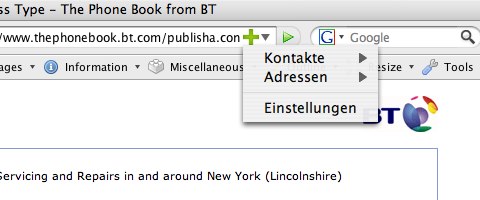
    …ein semantisches Feuerwerk 😉

    with-greasemonkey.jpg

    Um die Userscripts einfach finden zu können, sind alle mit „monkeyformats“ ge-tagged. Leider funktioniert das einzige Script für einen Deutschen Service (DasTelefonbuch.de) nicht so richtig.

    3 Kommentare zu Monkeyformats
  • Das hCardMapper WordPress Plugin hat jetzt sein eigenes Repository bei WordPress.org.

    Keine Kommentare zu WP-hCardMapper hat ein neues Zuhause
  • Wie in meinem letzten Post über den hCardMapper beschrieben, war es in der Tat nicht möglich den Microformats-Parser/Proxy ohne weitere Probleme auszutauschen. Die generierten JSON Formate der einzelnen Parser (ufXtract, hKit, mofo) unterscheiden sich an einigen Stellen zu sehr um sie alle gleich behandeln zu können. Soweit zur schlechten Nachricht…

    Die gute Nachricht ist, dass sich Gordon Oheim (der Macher des hCardMappers) nochmal alle JSON Formate vorgenommen und eine neue Version gebastelt hat:

    v0.94 – Added better support for JSON returned by Optimus, ufXtract and hKit.

    Der Mapper sollte also mit mofo, Optimus, ufXtract and hKit problemlos funktionieren.

    Die nächste tolle Nachricht ist, dass Gordon auch auf einen kleinen Änderungswunsch von mir sofort eingegangen ist, so dass wir euch jetzt eine hCardMapper Edition von dem WordPress hCard-Commenting Plugin anbieten können :).

    Download: hCardMapper for WordPress v0.1 hCardMapper bei WordPress.org

    Wenn ihr immer die aktuelle Version haben wollt, hier ist der Link zum SVN.

    Ich hab das Plugin auch mal auf notizBlog aktiviert und würde mich über euer Feedback freuen. Macht es Sinn über das Admin-Menü zwischen beiden Versionen (hCard-Commenting und hCardMapper-Commenting) zu wechseln?

    Ein dickes Danke nochmal an Gordon für seine tolle und schnelle Arbeit… tolles Script.

    2 Kommentare zu hCardMapper für WordPress
  • Um auf die im HTML-Quellcode verwendeten Microformats hinweisen zu können, wurden vom Microformats-Team jetzt einheitliche Profile URIs veröffentlicht. Berücksichtigt wurden alle non-draft Microformats (Stand: März 2008) ausgenommen XOXO und XMDP:

    SpecificationProfile(s)
    geo http://purl.org/uF/geo/0.9/
    hAtom http://purl.org/uF/hAtom/0.1/
    hCalendar http://purl.org/uF/hCalendar/1.0/
    hCard http://www.w3.org/2006/03/hcard or http://purl.org/uF/hCard/1.0/
    hResume http://microformats.org/wiki/hresume-profile
    rel-license http://purl.org/uF/rel-license/1.0/
    rel-nofollow http://purl.org/uF/rel-nofollow/1.0/
    rel-tag http://purl.org/uF/rel-tag/1.0/
    VoteLinks http://purl.org/uF/VoteLinks/1.0/
    XFN http://gmpg.org/xfn/11

    Eine komplette Übersicht findet man auch über purl.org/uF/2008/03/ oder im Microformats Wiki.

    Diese URIs können, gemäß der W3C namespace policy <head /> der HTML Datei angegeben werden. Beispiel:

    <head profile="http://www.ietf.org/rfc/rfc2731.txt
                   http://www.w3.org/2006/03/hcard
                   http://purl.org/uF/hAtom/0.1/">Code-Sprache: HTML, XML (xml)

    Quelle: ‘This Week in Microformats’ für März.

    Keine Kommentare zu Microformats Profile URIs
  • …oder How to use hCards to fill in forms.

    hCardMapper ist eine JavaScript-Klasse (basierend auf Prototype) um Kontakt- oder Profil-Formulare mit Hilfe einer hCard automatisch zu füllen, ähnlich wie bei bragster.com oder getsatisfaction.com.

    Das schöne an hCardMapper ist seine flexible Struktur. Die JavaScript Klasse ist so aufgebaut, dass sie eigentlich Microformats-Parser unabhängig funktionieren sollte, da sie die Daten über einen „Proxy“ abfrägt. Die einzige Vorgabe ist, dass dieser Proxy eine JSON formatierte hCard (jCard) zurückgibt. Das Problematische an dieser Variante ist, dass jeder Parser unterschiedliche Ergebnisse liefert… ich werde es heute abend mal mit dem hKit-Parser testen.

    Ein weiter Vorteil ist die Formular-Unabhängige Programmierung die es ermöglicht, das Script auch problemlos auf vorhandene Formulare anzuwenden. Über mappnings werden die hCard-Attribute den entsprechenden Formular-Felder zugeordnet.

    Event.observe(window, 'load', function() {
      hcr = new com.omniacomputing.HCardMapper({
        register: true,
        proxy: '/hcardmapper/hcard?uri=',
        insertBelowEl: 'hcr-hook',
        mappings: {
          given_name: 'first',
          family_name: 'last',
          tel: {tel: 'phone', work: 'phone', cell:'phone'},
          email: 'email',
          org: {org: 'company', organization_name: 'company'},
          url: 'website',
          street_address: 'street',
          postal_code: 'zip',
          locality: 'town' 
        }
      })
    });Code-Sprache: JavaScript (javascript)

    Quelle: http://lib.omnia-computing.de/hcardmapper

    Tolle Idee, mal schau’n wie gut das Script mit den (oben schon erwähnten) unterschiedlichen Verarbeitungsweisen der Parser umgeht…

    Keine Kommentare zu hCard Mapper